Release Notes
Stay up to date with the latest features, improvements, and bug fixes in SkyPortal.
What's New in v1.2
Version: 1.2
Release Type: Feature & Reliability Update
Status: General Availability
1. Overview
Version 1.2 delivers significant improvements to the SkyPortal AI Chat experience, backend reliability, and platform analytics. Key highlights include a redesigned turn-based conversational interface, smarter error recovery, and improved agent command routing.
2. Turn-Based Conversational UI with Collapsible Actions
The AI Chat interface has been redesigned with a turn-based conversational model:
- Each agent turn is clearly separated, making conversations easier to follow
- Intermediate agent actions (tool calls, reasoning steps) are grouped into collapsible sections — keeping responses clean while still exposing full detail on demand
- Improved readability for long multi-step agent interactions
This update makes working with the SkyPortal Agent feel more like a natural back-and-forth conversation, with less visual clutter from tool call outputs.
3. Faster & More Reliable Agent Command Execution
Agent commands are now routed through Celery, SkyPortal's background task queue, instead of the previous xterm WebSocket path. Benefits include:
- More robust handling of long-running commands
- Commands continue executing even if the browser tab is temporarily inactive
- Improved visibility into task status and queuing
4. Smarter Context Window Management
The agent now gracefully handles situations where a conversation grows too long for the model's context window:
- Automatically applies progressive history truncation to trim older messages when the limit is reached
- Conversations that previously failed with a context overflow error now continue seamlessly
- Older, less relevant turns are pruned first to preserve recent context
5. Improved Error Monitoring for Agent Iterations
ReAct iteration errors (errors that occur during the agent's reasoning loop) are now automatically captured and reported to Sentry. This allows the SkyPortal team to proactively identify and resolve agent reliability issues.
6. Reddit Pixel Analytics
A Reddit Pixel has been added across all SkyPortal pages to support marketing attribution and better understand how users discover the platform.
7. Impact Summary
- Better UX: Turn-based chat UI makes agent interactions clearer and more intuitive
- Higher Reliability: Celery-based command routing and context overflow recovery reduce failure rates
- Improved Observability: Sentry error capture for agent loops enables faster incident response
Skyportal Host Management – Release Notes
Version: 1.0
Release Type: Major Feature Expansion
Status: General Availability
1. Overview
This release introduces the full production version of Skyportal Host Management, marking a significant evolution from the initial beta. The Skyportal Agent has now matured into a fully autonomous ML infrastructure assistant capable of discovering, configuring, orchestrating, and observing compute environments across clouds and on-prem systems.
This version delivers a unified control plane for:
- Multi-cloud host connectivity
- Environment awareness
- Autonomous system configuration
- Remote data access
- Dependency resolution
- Experiment observability
This release enables infrastructure to operate as a living system—adaptive, inspectable, and self-optimizing.
2. Cross-Cloud Host Access via Secure SSH
Skyportal now supports direct, secure SSH connectivity to any host across any cloud or on-prem environment. With a single host registration step, users can:
- Attach AWS, GCP, Azure, and on-prem machines
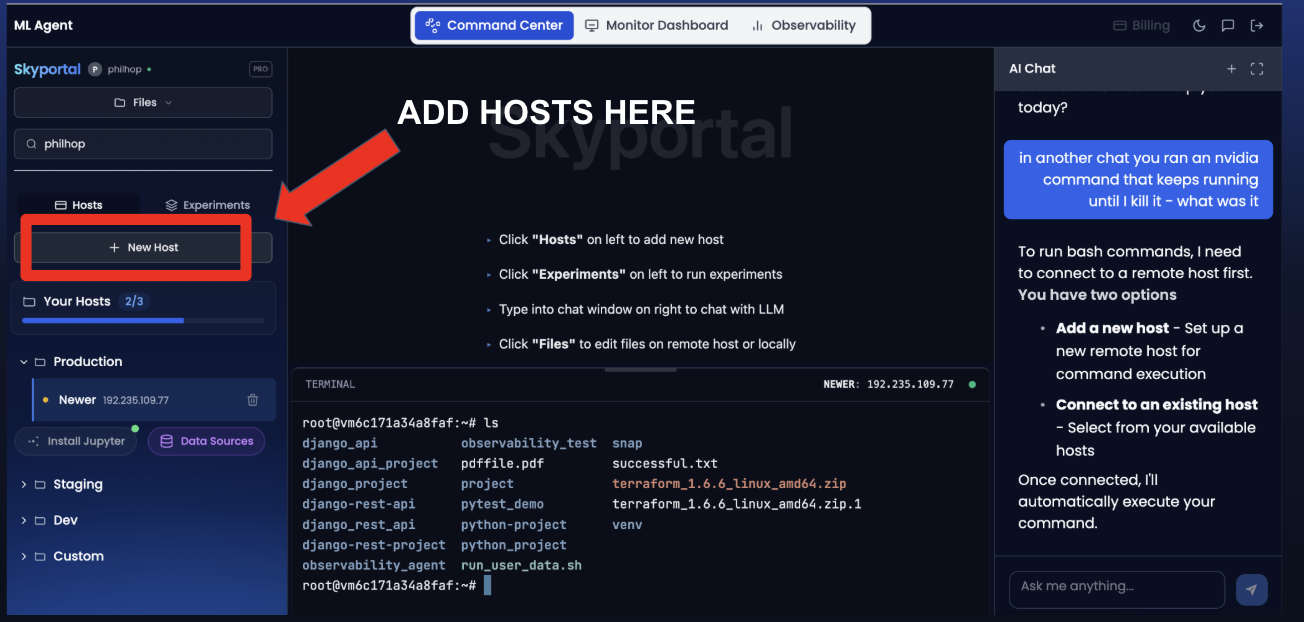
- Authenticate using SSH keys
- Maintain persistent secure connections
- Add many hosts and click to interact with each

- Switch between hosts instantly
- Execute commands via:
- Skyportal's built-in terminal
- The Skyportal Agent conversational interface
This removes the need for manual SSH workflows and fragmented access tools.
3. Automatic Hardware & Software Environment Detection
Once a host is connected, the agent performs automatic full-stack environment introspection, including:
- CPU architecture and core counts
-
GPU model, memory, and driver versions

-
CPU/GPU utilization, memory and storage levels

-
Python versions and library versions

- CUDA, cuDNN, and ML framework versions
- Active system and training processes
All detected metadata is continuously synchronized into the Skyportal Monitoring Dashboard, giving users a real-time, authoritative view of their entire compute fleet.
4. Unified Multi-Host Management Interface
Users can now manage unlimited hosts from a single unified interface:
- One-click host switching
- Parallel terminal sessions
- Unified agent chat across all hosts
- Centralized monitoring
- Shared access control
This turns multiple machines into a single logical compute fabric that can be operated through a single UI and agent brain.
5. Optional Automatic Jupyter Notebook Provisioning
For interactive workflows, Skyportal provides optional one-click Jupyter provisioning on any connected host:
- Secure token-based access
- Remote kernel execution
- GPU-enabled notebook support
- Environment-aware kernel binding
- Automatic port management
This eliminates manual notebook setup and firewall configuration across remote systems.
6. One-Click Remote Data Source Integration
Skyportal enables direct integration with external data platforms through a one-step secure credential workflow. Supported sources include:
- PostGres
- S3
- Snowflake
- Other S3-compatible object stores
Once connected:
- All managed hosts gain secure access
- Credentials are encrypted and isolated per host
- Data can be streamed directly into training jobs
- No manual key distribution is required
This enables distributed training workloads to securely access centralized datasets without operational friction.
7. Proactive Host Configuration via Autonomous Agent
The Skyportal Agent now performs proactive configuration management based on live environment state:
- Detects incompatible library versions
- Identifies driver mismatches
- Flags missing system dependencies
- Identifies GPU runtime failures
- Detects memory and disk misconfigurations
The agent does not merely report issues—it actively proposes fixes and can automatically apply them with user confirmation.
8. Automated Dependency Conflict Resolution
The agent now performs cross-layer dependency resolution between:
- Hardware
- Drivers
- CUDA runtime
- ML frameworks
- Python libraries
- Training code
This includes:
- Automatic uninstall / upgrade scheduling
- Environment isolation
- Driver-framework compatibility enforcement
- Rollback safety for failed changes
This drastically reduces system breakage caused by version drift.
9. Model-Aware Optimization Intelligence
The Skyportal Agent now analyzes:
- Model architecture type
- Training vs inference workloads
- Dataset format, size, and distribution
- Available system resources
Based on this data, the agent provides optimization recommendations, including:
- Batch-size tuning
- Precision mode selection
- GPU vs CPU execution
- Data pipeline optimization
This transforms the agent into a performance advisor—not just a system operator.
10. Unified Experiment Observability (Weights & Biases-Compatible)
Every experiment executed on any registered host automatically becomes observable within Skyportal's Observability Dashboard, assuming the training code is instrumented with Weights & Biases.
Features include:
- Real-time metric streaming
- Loss and accuracy charts
- Resource utilization overlays
- Cross-host experiment comparisons
- Run versioning and history
This gives users enterprise-grade experiment tracking without deploying separate observability stacks.
11. Impact Summary
This release transforms Skyportal from a beta connectivity tool into a true AI infrastructure operating system:
- Hosts become autonomous compute nodes
- Environments become self-aware
- Training becomes observable by default
- Data access becomes frictionless
- Configuration becomes proactive
- Dependency management becomes autonomous
Infrastructure is no longer passive. It becomes an intelligent system.
12. Next Phase
Future releases will extend Host Management into:
- Distributed multi-host orchestration
- Autonomous failure recovery
- Predictive capacity planning
- Model lifecycle automation
- Enterprise policy enforcement
Skyportal Host Management v1.0 is the foundation of Autonomous Infrastructure.